

Top 10 Problems Businesses Face When Managing Leads on WhatsApp
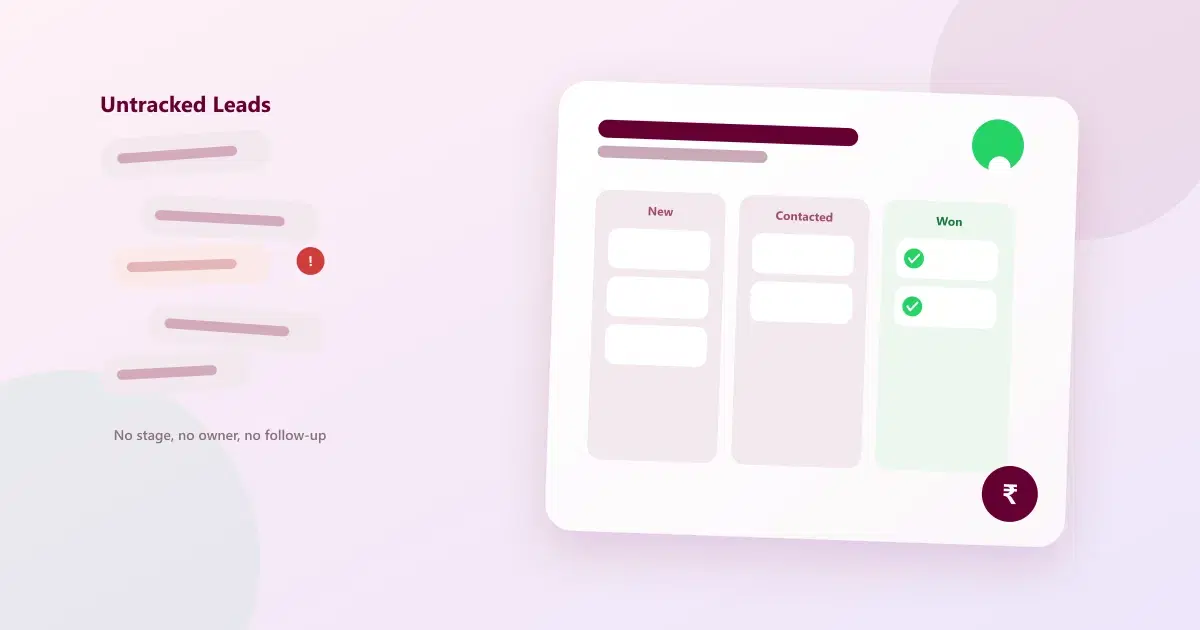
WhatsApp leads pile up fast, but managing them is another story. Here are the top 10 problems businesses hit tracking, assigning, and following up on WhatsApp leads — and how to fix each one.
WhatsApp is where most Indian businesses now get their leads — but very few actually manage those leads once they arrive. A lead that lands in a chat thread isn't automatically tracked, assigned, or followed up on; it just sits there until someone happens to notice it. This guide covers the top 10 problems businesses face when managing leads on WhatsApp, and what a proper WhatsApp lead management process actually looks like.
Why WhatsApp Lead Management Breaks Down As You Grow
WhatsApp is built for conversations, not for managing a pipeline of leads. There's no built-in way to tag a chat as "new," "in progress," or "won," no shared view across a team, and no reminder system beyond a manually set phone alarm. This is invisible at low volume — one person can track five leads in their head. It becomes a real business problem once leads are coming from multiple sources, multiple staff are replying, and nobody has a clear, shared answer to "where does this lead actually stand?"
Quick Reference — The 10 Problems at a Glance
| # | Problem | Root Cause |
|---|---|---|
| 1 | Leads aren't captured automatically | No system logging new chats as leads |
| 2 | No record of who a lead is assigned to | No shared ownership, just whoever replied first |
| 3 | Duplicate leads from repeat messages | No deduplication against existing contacts |
| 4 | No way to prioritise hot leads | Every chat looks the same in the inbox |
| 5 | Leads get buried in long chat threads | No stage or status markers on a conversation |
| 6 | No visibility into a lead's current stage | No pipeline view, just a list of chats |
| 7 | Follow-ups aren't scheduled or tracked | No reminder system tied to the lead itself |
| 8 | Multiple staff reply inconsistently | No shared context on what's already been said |
| 9 | No reporting on source or conversion rate | No structured data behind the conversations |
| 10 | Leads go cold when staff are busy or off | Leads tied to one person, not a shared system |
Top 10 Problems Businesses Face When Managing Leads on WhatsApp
1. Leads Aren't Captured Automatically
A new enquiry on WhatsApp is just a message — nothing marks it as a lead unless a person manually notices it and writes it down somewhere else. If that step gets skipped during a busy hour, the lead effectively doesn't exist in any record the business can act on later.
2. No Record of Who a Lead Is Assigned To
Without a shared system, lead ownership defaults to "whoever replied first" — which means no one else on the team knows if it's being followed up on, and two people can end up either duplicating effort or, more often, both assuming someone else has it covered.
3. Duplicate Leads From the Same Customer Messaging Multiple Times
A customer who messages once, doesn't hear back quickly, and messages again often gets treated as two separate enquiries instead of one lead needing a faster response — inflating lead counts while masking the actual problem.
4. No Way to Prioritise Hot Leads Over Cold Ones
In a plain chat list, a customer ready to buy today looks identical to someone who asked a casual question three weeks ago. Without a way to flag urgency, high-intent leads can sit unanswered behind lower-priority chats simply because of message order.
5. Leads Get Buried in Long Chat Threads
As a conversation grows — questions, answers, a bit of small talk — the actual lead information gets buried further down with every new message, making it harder for anyone else to quickly understand where things stand.
6. No Visibility Into a Lead's Current Stage
Is this lead still deciding, waiting on a quote, or ready to close? Without a shared pipeline view, that answer lives only in the memory of whoever last spoke with them — invisible to managers and to any other staff member who might need to step in.
7. Follow-Ups Aren't Scheduled or Tracked
"I'll follow up with them later" is not a system — it's a hope. Without a reminder tied directly to the lead, follow-up depends entirely on someone happening to remember, on a day when they're not already busy with something else.
8. Multiple Staff Reply to the Same Lead Inconsistently
When more than one staff member can respond to the same number, a lead can get contradictory answers — different pricing, different availability — because nobody replying has full visibility into what's already been said.
9. No Reporting on Lead Source or Conversion Rate
Which marketing channel actually brings in leads that convert? Without structured data behind the conversations, that question can't be answered — only guessed at, which makes it hard to know where to spend time or budget next.
10. Leads Go Cold When Staff Are Busy or Off
If a lead exists only in one person's chat app, their absence — a busy day, a day off, leaving the company — means the lead simply doesn't get followed up on at all, with no one else even aware it was waiting.
How to Fix WhatsApp Lead Management
Every problem above traces back to the same root cause: leads existing only inside individual chat threads, with no shared, structured layer on top. Fixing it doesn't mean abandoning WhatsApp — it means connecting it to a system that can:
- Automatically log every new conversation as a lead, without relying on someone to remember
- Assign clear ownership, visible to the whole team, not just the person who replied first
- Track a lead's stage — new, contacted, quoted, won, lost — separate from the chat itself
- Schedule and track follow-ups automatically, rather than relying on memory
- Report on source and conversion, so decisions are based on real numbers, not impressions
How Cleomitra Helps
Cleomitra connects WhatsApp lead management directly to a CRM, so leads don't have to live only inside chat threads:
- Automatic lead capture from new WhatsApp conversations, logged against a CRM contact
- A shared team inbox, so lead ownership and history are visible to everyone, not just one phone
- Customer tags and stage tracking, so leads don't get buried in a plain chat list
- Automated follow-up reminders, so a lead doesn't go cold just because someone got busy
- Built-in reporting, so lead source and conversion numbers are available without manual tracking
- India-first pricing, with plans starting from around ₹499/month, so this is realistic for a small team, not just larger sales operations
Related Guides
Frequently Asked Questions
What is the biggest problem with managing leads on WhatsApp?
The biggest problem is that WhatsApp has no built-in way to track a lead's status, ownership, or follow-up schedule — a lead is just a chat thread, so it's easy for it to sit unanswered or get forgotten once the conversation isn't actively open.
Why do WhatsApp leads go cold so easily?
WhatsApp leads go cold because follow-up usually depends on one staff member remembering to respond. If that person is busy, off, or simply loses track in a growing list of chats, there's no automated system prompting the follow-up instead.
How can businesses avoid duplicate leads on WhatsApp?
Duplicate leads are avoided by matching new messages against existing contact records rather than treating every new message thread as a brand-new enquiry — this is one of the core things a CRM connected to WhatsApp does automatically.
Can WhatsApp be used for lead management without a CRM?
It can at a very small scale, with one or two people managing a handful of leads manually. Beyond that, the lack of shared visibility, tracking, and follow-up automation makes plain WhatsApp lead management unreliable as a business grows.
How do you prioritise leads when they all come in through the same WhatsApp number?
Prioritisation requires some way to tag or score leads by intent or urgency — something a plain chat list doesn't support. A CRM connected to WhatsApp can flag high-intent leads so they don't get buried behind lower-priority conversations.
What should a business track for each WhatsApp lead?
At minimum: who the lead is, which stage they're at, who's responsible for following up, when the last contact happened, and where the lead originally came from. Tracking this in the chat thread alone makes it invisible to the rest of the team.
Does connecting WhatsApp to a CRM fix lead management problems?
Yes, for most of the problems covered here — a CRM adds shared ownership, stage tracking, automated follow-up reminders, and reporting on top of WhatsApp, without changing the number or app customers already use to reach the business.
