

WhatsApp Cloud API Explained: Coexistence, No BSP Markup, and Why It's Better Than Going Through a Reseller
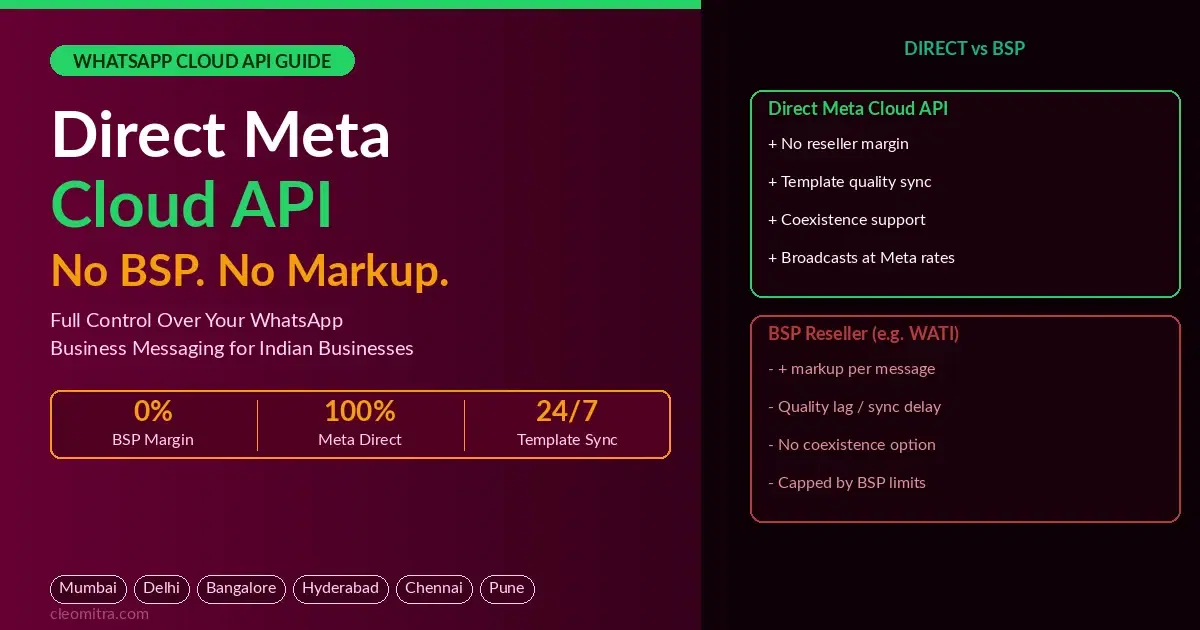
Most Indian businesses access WhatsApp through a BSP reseller — and pay a hidden per-message markup for it. This guide explains Meta's WhatsApp Cloud API, how direct access removes the BSP margin, what WhatsApp Coexistence is, and why it matters for your business in Mumbai, Delhi, Bangalore, Hyderabad, Chennai, and Pune.
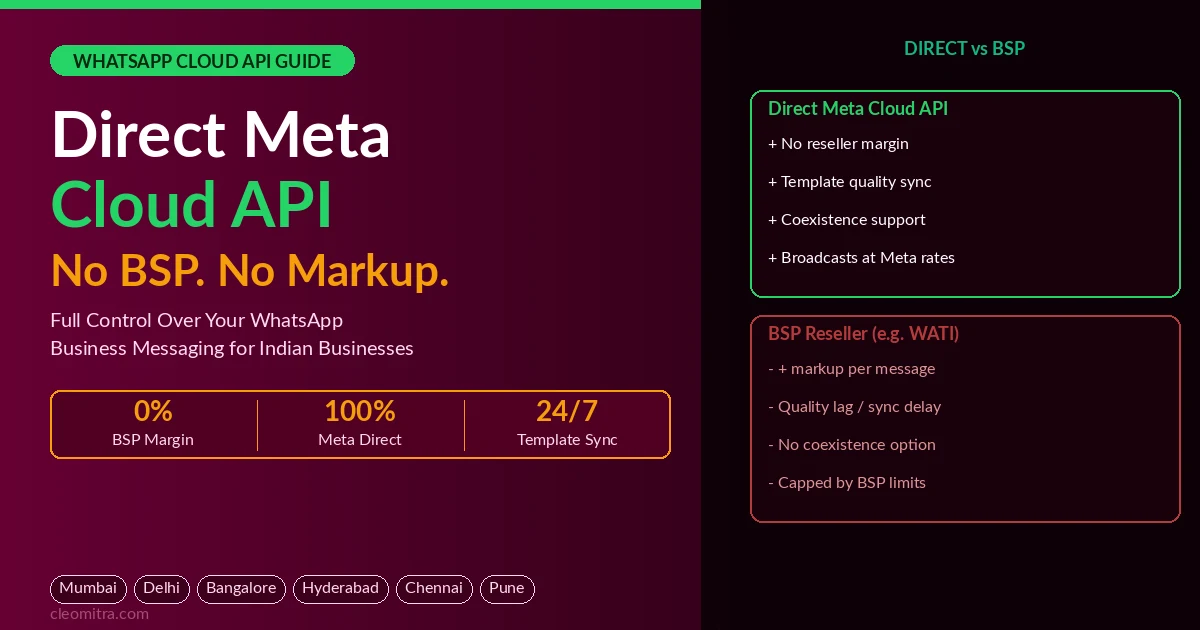
Most businesses in India that add WhatsApp to their customer communication stack do so through a Business Solution Provider (BSP) — a reseller layer that sits between their software and Meta's actual API. It works, but it comes with a cost that rarely shows up clearly in the pitch: a per-message or per-conversation margin that compounds with every automation you run.
There is a direct alternative. Meta's WhatsApp Cloud API — available since 2022 — allows platforms to connect straight to Meta's infrastructure without a BSP intermediary. For Indian businesses in Mumbai, Delhi, Bangalore, Hyderabad, Chennai, and Pune sending thousands of WhatsApp messages per month, this distinction translates directly into lower operating costs, faster template management, and access to features like Coexistence that most BSP resellers don't support.
This guide explains exactly what changes when you go direct, and why it matters for your business in 2026.
What Is the WhatsApp Cloud API — and How Does BSP Resale Work?
The WhatsApp Cloud API is Meta's officially hosted version of the WhatsApp Business API. Before 2022, businesses that wanted programmatic WhatsApp access had to host the API themselves (the on-premises version) or go through an approved BSP — a third-party company certified by Meta to resell API access. In 2022, Meta changed this by launching the Cloud API, which Meta itself hosts and which any platform can integrate with directly.
Here is how the two models compare:
The BSP Resale Model
Under this model, your business signs up with a BSP (such as WATI, Interakt, or similar platforms). The BSP has its own Meta Business account and acts as a relay: your messages flow through the BSP's infrastructure before reaching Meta's network. The BSP pays Meta's base rate and charges you a marked-up rate on top. This markup is not always made explicit — it can appear as a per-conversation fee, a monthly "API access" charge, or a tiered messaging bundle.
The Direct Cloud API Model
Under this model, a platform like Cleomitra integrates directly with Meta's Cloud API using its own Meta Business account. There is no relay, no reseller, and no third-party margin sitting between your business and Meta. You pay for what Meta charges — nothing more. The platform's revenue comes from its software subscription, not from a markup on your messaging volume.
The practical result: at scale, the cost profile between these two models diverges significantly.
The Hidden Cost of BSP Margins
BSP pricing is often opaque by design. The headline number — a monthly SaaS fee — looks reasonable. What's less visible is the per-conversation or per-template markup that runs in parallel.
Meta charges for WhatsApp Business conversations in categories (marketing, utility, authentication, service), with rates in India typically ranging from approximately ₹0.40 to ₹1.10 per conversation depending on category. A BSP adds a reseller margin — commonly estimated between 30–50% — on top of Meta's base rates.
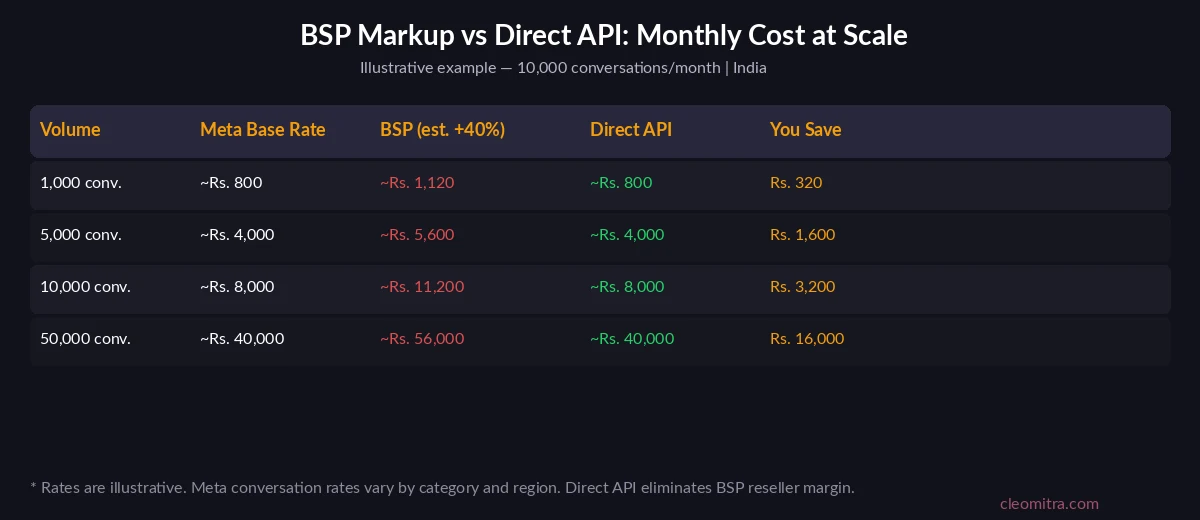
At low volumes (under 1,000 conversations/month), the margin difference is small enough to ignore. At 10,000 conversations/month — routine for an active Indian e-commerce business, salon chain, or education platform — the difference becomes meaningful. At 50,000+ conversations/month, it represents a significant recurring overhead that could fund additional marketing or product investment.
Beyond raw cost, BSP margins create a second problem: incentive misalignment. A BSP profits when you send more messages. A direct-access platform profits when your software subscription continues — meaning its incentives align with delivering value, not driving volume.
Full Template Lifecycle, Quality Sync, and Versioning
Every WhatsApp Business message sent outside of the 24-hour customer service window requires a pre-approved message template. Templates go through a quality review by Meta, receive quality ratings (High, Medium, Low), and can be paused by Meta if they generate high opt-out or spam rates. Managing this lifecycle efficiently is critical for any business running active WhatsApp campaigns.
With a Direct Meta Cloud API integration, the platform managing your account can:
- Sync template status in real time — quality rating changes, approvals, and pauses reflect immediately in your dashboard without waiting for a BSP's polling cycle
- Version templates properly — maintain separate versions of templates under review, live, or retired without risking live campaign disruption
- React to quality degradation instantly — if a template's quality drops, the platform can pause campaigns and notify you before Meta forces a suspension
- Iterate faster — template approval submissions go directly to Meta rather than waiting in a BSP's queue, reducing turnaround from days to hours
For Indian businesses in high-frequency use cases — appointment reminders for clinics and salons in Hyderabad and Bangalore, order updates for e-commerce operations in Mumbai and Delhi, or student communication for ed-tech platforms across Chennai and Pune — template reliability is not optional. A paused template during a peak campaign window costs real revenue.
Broadcasts, Recurring Campaigns, Groups, and Flows
One of the most commercially valuable aspects of the WhatsApp Cloud API is the ability to send outbound messages at scale — not just respond to inbound conversations. With direct API access, your platform can build structured automation flows that BSP-mediated connections often restrict or tier by pricing plan.
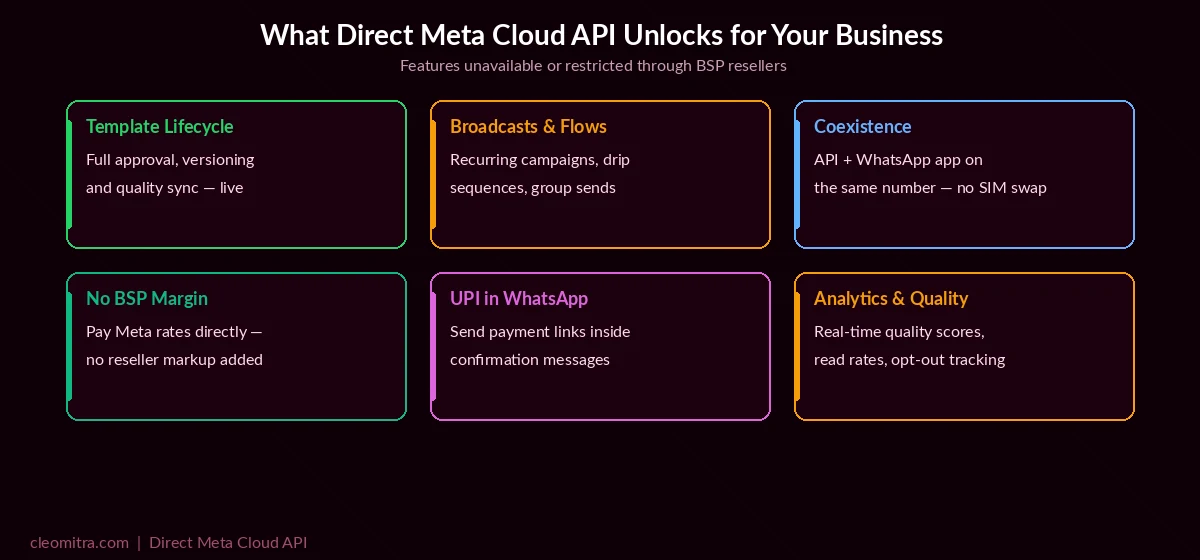
Broadcasts
Send promotional or informational messages to opted-in customer segments simultaneously. A salon in Pune can broadcast a Diwali offer to 2,000 clients in one action. An ed-tech platform can broadcast exam schedule updates to enrolled students across Delhi and Kolkata. Broadcasts require pre-approved templates and opted-in contacts — these are the guardrails that keep WhatsApp a high-trust channel.
Recurring Campaigns
Automate time-based message sequences: monthly loyalty reminders, quarterly renewal nudges, weekly appointment slot availability alerts. Recurring campaigns run without manual intervention once configured, making them a genuine operational multiplier for small Indian businesses that can't afford a full marketing operations team.
Structured Flows
Build multi-step conversational flows — a customer books an appointment via a WhatsApp button, receives a confirmation, gets a reminder 24 hours before, and receives a post-visit review request. Each step is automated, template-based, and tracked. This kind of end-to-end WhatsApp automation is only possible with reliable API access and proper template lifecycle management.
Group Messaging
For B2B contexts — sending updates to reseller groups, field team communications, or customer cohort notifications — direct API access allows structured group send patterns within Meta's permitted use cases.
Coexistence — Keep Your Number and Your App
One of the most common objections to WhatsApp API adoption, particularly from small and medium businesses across India, is this: "If I connect my number to the API, I'll lose access to the WhatsApp Business app on my phone."
Until 2023, this was true. Connecting a phone number to the WhatsApp Business API meant that number could no longer be used on a device — it became purely API-managed. For a solo salon owner in Jaipur, a freelance consultant in Coimbatore, or a small retail shop in Lucknow that manages client relationships personally over WhatsApp, this was a dealbreaker.
Meta's Coexistence feature removes this constraint entirely.
How Coexistence Works
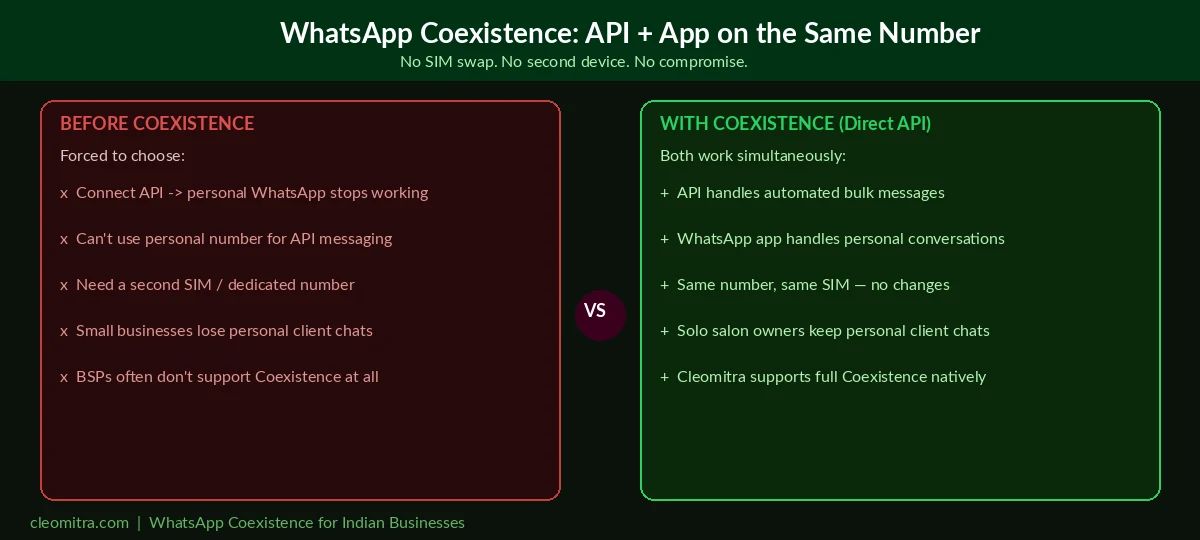
With Coexistence enabled, your WhatsApp number runs two channels simultaneously:
- The API channel handles automated messages — booking confirmations, broadcast campaigns, appointment reminders, UPI payment links, and post-visit follow-ups sent through your salon or business software
- The WhatsApp Business app continues operating on your phone as normal — you can respond to personal client messages, handle ad-hoc queries, and maintain the direct relationship feel that Indian clients expect
- No SIM swap required — both channels share the same phone number and operate without device-level changes
- Seamless handoff — automated API messages and personal app messages appear in the same thread from the client's perspective, maintaining conversation continuity
Why Most BSPs Don't Support Coexistence
Coexistence is a Direct Cloud API-level feature — it requires a direct Meta integration to implement correctly. BSPs that use their own Meta Business accounts as a relay layer cannot pass through Coexistence support to their end customers. If your WhatsApp integration runs through a BSP, you are almost certainly not on Coexistence — and cannot be, without switching to a platform with a direct integration.
Cleomitra supports full WhatsApp Coexistence natively, having built directly on Meta's Cloud API from the outset.
Why This Matters for Your Business in India
The cumulative impact of going direct rather than through a BSP layer shows up across three dimensions:
- Lower total messaging cost — no reseller margin means every rupee of WhatsApp spend goes to actual message delivery at Meta's published rates, not to a BSP's margin stack
- Faster campaign execution — direct template approval pipelines, real-time quality sync, and no BSP queue delays mean your campaigns go live faster and recover faster when a template is paused
- No vendor lock-in on messaging infrastructure — because the phone number and template library live in your Meta Business account (not the BSP's), switching platforms doesn't mean losing your WhatsApp history or needing to re-register numbers
- Coexistence access — a feature that is simply unavailable through BSP-mediated integrations, and which is commercially significant for Indian SMBs managing personal client relationships
For Indian businesses across sectors — salons and spas in Mumbai and Hyderabad, ed-tech platforms serving students across Delhi, Bangalore, and Chennai, retail and D2C brands in Pune and Kolkata — the WhatsApp channel is often the highest-engagement touchpoint with customers. Getting the infrastructure right matters.
Businesses evaluating WhatsApp Cloud API solutions can also compare WhatsApp CRM pricing and features across the top platforms in India, including automation and shared inbox capabilities.
Explore Cleomitra's Direct Meta Cloud API Integration
Cleomitra connects directly to Meta's WhatsApp Cloud API — not through a BSP reseller. This means no markup on your messaging volume, full template lifecycle management inside the platform, native Coexistence support so you keep your personal WhatsApp running on the same number, and broadcast and flow capabilities without BSP-imposed limits.
If you're currently using a BSP-mediated WhatsApp integration and want to understand what switching to a direct connection would look like for your business, explore Cleomitra's free trial or speak with the team.
Frequently Asked Questions
What is the difference between WhatsApp Cloud API and WhatsApp Business API?
The WhatsApp Business API is the umbrella term for Meta's API-based access to WhatsApp. The Cloud API is the specific, Meta-hosted version launched in 2022 that eliminates the need for on-premises server hosting and allows direct platform integration without a BSP intermediary.
What is a WhatsApp BSP and why does it add cost?
A BSP (Business Solution Provider) is a Meta-certified reseller of WhatsApp API access. BSPs add a per-conversation or per-message markup on top of Meta's base rates, which compounds at volume. This margin covers the BSP's infrastructure costs and profit, and is not always transparently disclosed in their pricing.
Can any business connect directly to Meta's WhatsApp Cloud API?
Yes, but the direct connection is typically made at the platform level — meaning your salon software, CRM, or business tool integrates directly with Meta's Cloud API on your behalf. You don't build the API integration yourself; you choose a platform (like Cleomitra) that has done so directly.
What is WhatsApp Coexistence and does it require a new number?
WhatsApp Coexistence allows your existing phone number to run both the WhatsApp Business app and the Cloud API simultaneously. It does not require a new number, SIM swap, or second device. You keep your personal WhatsApp conversations while automated API messages also run on the same number.
Do BSPs support WhatsApp Coexistence?
Generally, no. Coexistence is a Direct Cloud API feature. Because BSPs use their own Meta Business accounts as a relay, they cannot pass through Coexistence capabilities to their end customers. Platforms with direct Cloud API integrations — like Cleomitra — support Coexistence natively.
What are WhatsApp message templates and why do they matter?
Message templates are pre-approved message formats required for sending outbound WhatsApp messages outside the 24-hour customer service window. They go through Meta's quality review, receive quality ratings, and can be paused if they generate high opt-out rates. Managing templates efficiently is critical for campaign reliability.
How does WhatsApp pricing work in India for businesses?
Meta charges per conversation in India, with rates varying by category: marketing conversations, utility messages, authentication messages, and service conversations each have different rates, typically ranging from approximately ₹0.40 to ₹1.10 per conversation. BSP resellers add a markup on top of these base rates.
What is WhatsApp template quality sync and why is it important?
Template quality sync refers to real-time synchronisation of a template's Meta quality rating and approval status into your platform. Without direct API access, quality rating changes may be delayed, causing campaigns to continue sending on a degraded or paused template. Direct platforms sync quality status instantly.
Can I switch from a BSP to a direct Cloud API platform without losing my WhatsApp number?
Yes. Your WhatsApp phone number is associated with your Meta Business Account, not with the BSP. Migrating to a platform with a direct Cloud API integration typically involves transferring the number to the new platform's integration, a process Meta supports without requiring you to change your number.
Is Cleomitra a BSP or a direct Meta Cloud API platform?
Cleomitra integrates directly with Meta's WhatsApp Cloud API. It is not a BSP reseller. This means there is no BSP margin on your messaging volume, and features like full template lifecycle management and WhatsApp Coexistence are available natively within the Cleomitra platform.
