

Top 10 Reasons Businesses Lose Repeat Customers—and How to Bring Them Back
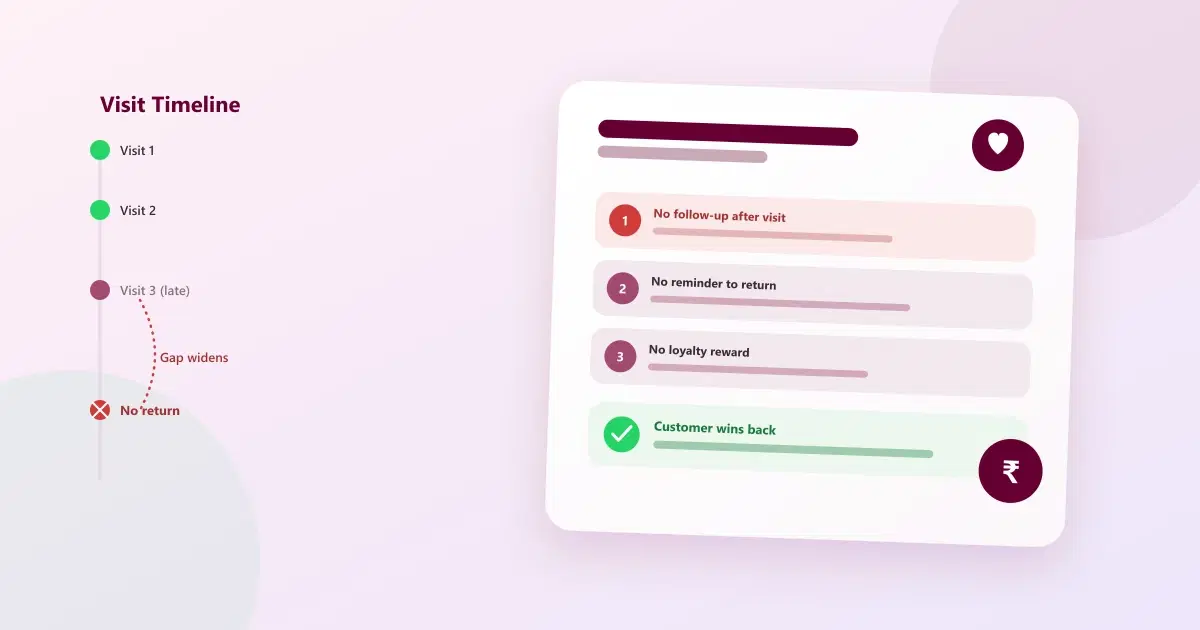
Repeat customers rarely leave loudly — they just stop coming back. Here are the top 10 reasons businesses lose repeat customers, with the specific fix for each.
Losing a repeat customer rarely looks like anything dramatic — no complaint, no cancellation, just a customer who quietly stops coming back. By the time a business notices the gap, that customer has usually already found somewhere else to go. This guide covers the top 10 reasons businesses lose repeat customers, and exactly how to bring them back with a system instead of guesswork.
Why Repeat Customers Slip Away Without Anyone Noticing
A first-time customer is easy to track — the sale itself is proof they showed up. A repeat customer is different: there's no single moment where they "leave." They simply stop responding to reminders that were never sent, stop feeling remembered by a business that treats every visit like the first, and eventually stop thinking of your business at all. Customer retention problems are almost always a process gap, not a product problem — and every reason below has a specific, fixable cause.
Quick Reference — Reasons & Fixes at a Glance
| # | Reason | Primary Fix |
|---|---|---|
| 1 | No follow-up after the first visit | Automatic post-visit thank-you and rebooking nudge |
| 2 | Inconsistent service across visits | Shared customer notes visible to every staff member |
| 3 | No memory of past purchases or preferences | Centralised customer history in a CRM |
| 4 | Slow response when they reach out | A shared inbox with fast response tracking |
| 5 | No reminder when it's time to return | Automated, timing-based reminders per service |
| 6 | No reward for staying loyal | A visible loyalty milestone program |
| 7 | A bad experience was never resolved | Post-visit feedback capture with fast recovery |
| 8 | Price or policy changes with no warning | Proactive notice before any change takes effect |
| 9 | Switching felt easier than returning | One-message rebooking, as easy as a new competitor |
| 10 | Communication stops after the sale | Light-touch engagement between visits, not silence |
Top 10 Reasons Businesses Lose Repeat Customers—and How to Bring Them Back
1. No Follow-Up After the First Visit
Most businesses treat the first sale as the finish line instead of the start of a relationship. Without any follow-up, a happy first-time customer has no reason to think about the business again until they happen to need the service — by which point a competitor may already have their attention.
How to bring them back: Send an automatic thank-you message shortly after the visit, with a simple, direct way to book the next one.
2. Inconsistent Service Quality Across Visits
When a customer gets a noticeably different experience the second time — a different staff member with no notes on what they usually want — it feels like starting over instead of being a valued regular.
How to bring them back: Keep shared notes on preferences and history that any staff member can see, so the experience feels consistent regardless of who serves them.
3. No Memory of Past Purchases or Preferences
Having to re-explain past orders, preferences, or issues every single visit is exhausting for a genuinely loyal customer, and it signals that the business never really tracked the relationship in the first place.
How to bring them back: Store customer history centrally in a CRM, so context carries forward automatically instead of depending on memory.
4. Slow or Unresponsive Communication When They Reach Out
A returning customer who messages with a question or a complaint and waits hours for a reply quickly concludes they're no longer a priority — ironic, since repeat customers are usually the most valuable ones to respond to quickly.
How to bring them back: Route all customer messages into one shared inbox, and track first-response time as a real metric, not an afterthought.
5. No Reminder When It's Time to Come Back
Most services have a natural rhythm — a haircut, a health check-up, a subscription renewal — but without a reminder tied to that rhythm, the customer simply forgets until it's overdue, if they remember at all.
How to bring them back: Set up automated reminders timed to each service's actual return cycle, not a generic monthly blast to everyone.
6. No Reward for Staying Loyal
When a new customer gets a bigger discount than a loyal one, it sends the wrong signal — that loyalty isn't actually valued, and switching businesses every time might even be the smarter move.
How to bring them back: Build a visible loyalty milestone — a reward at the 5th or 10th visit — so staying is clearly worth more than leaving.
7. A Bad Experience Was Never Followed Up On
One disappointing visit doesn't have to end a relationship — but if it's never acknowledged or addressed, the customer quietly writes the business off instead of giving it a second chance.
How to bring them back: Ask for feedback after every visit, and have a fast, direct way to recover a customer who reports a problem.
8. Price or Policy Changes With No Warning
A surprise price increase or a new policy discovered mid-visit feels like a bait-and-switch, even when the change is entirely reasonable — the lack of warning is what damages trust.
How to bring them back: Communicate any change proactively, before it takes effect, so customers aren't caught off guard.
9. It Was Easier to Switch Than to Return
If a competitor lets a customer rebook with a single WhatsApp message while your business still requires a phone call during business hours, convenience alone can lose the repeat visit.
How to bring them back: Make rebooking as frictionless as replying to a message — a direct link or a simple reply should be enough.
10. Communication Stops Completely After the Sale
Total silence between visits, broken only by an occasional random promotional blast, doesn't feel like a relationship — it feels like being on a mailing list, easy to ignore and easy to forget.
How to bring them back: Keep a light, occasional touchpoint between visits — a useful tip, a milestone note, a relevant offer — without turning into spam.
How to Build a System That Brings Customers Back
None of these fixes require guessing what a customer wants — they require a system that remembers, reminds, and responds without depending on staff memory. This is exactly what Cleomitra is built for:
- Centralised customer records, so preferences and history carry forward automatically across every visit
- Automated WhatsApp reminders timed to each customer's actual visit cycle, not a generic broadcast
- A shared team inbox, so no customer message goes unanswered because one staff member was busy
- Loyalty tracking built in, so milestone rewards trigger automatically instead of being tracked manually
- India-first pricing, with plans starting from around ₹999/month, so this is realistic for small and growing businesses
Related Guides
Frequently Asked Questions
Why do businesses lose repeat customers even when they're satisfied?
Satisfied customers often drift away simply because nobody reminded them to come back, followed up after their visit, or made returning as easy as switching to a competitor — retention usually breaks down in the process, not in customer satisfaction itself.
What is the fastest way to bring back a lapsing customer?
A direct, personal follow-up message referencing their last visit — with an easy way to rebook — typically works faster than a generic discount blast, since it feels like the business actually noticed they were gone.
How often should a business follow up with repeat customers?
Follow-ups work best when tied to a real trigger — after a visit, near the natural return cycle for that service, or after a gap in activity — rather than on a fixed weekly or monthly schedule regardless of relevance.
Does a loyalty program actually help with customer retention?
Yes, when it's visible and easy to track — a clear reward at a specific visit milestone gives customers a concrete reason to keep choosing the same business instead of switching for a one-time new-customer discount elsewhere.
How important is response speed for keeping repeat customers?
Very important — a slow reply to a returning customer's message signals they're no longer a priority, and repeat customers are usually the most valuable group to respond to quickly, since they already have a relationship worth protecting.
Can small businesses automate customer retention without hiring extra staff?
Yes — a CRM connected to WhatsApp can automate follow-ups, visit reminders, and loyalty milestones based on real customer data, so retention runs on triggers instead of requiring someone to manually track every customer's visit history.
Does Cleomitra help bring back customers who've stopped visiting?
Yes. Cleomitra tracks customer visit history and can automatically send win-back and reminder messages on WhatsApp when a customer's activity gap crosses a set threshold, so lapsing customers get a nudge instead of being forgotten.
