

Top 10 Reasons Customers Stop Responding on WhatsApp
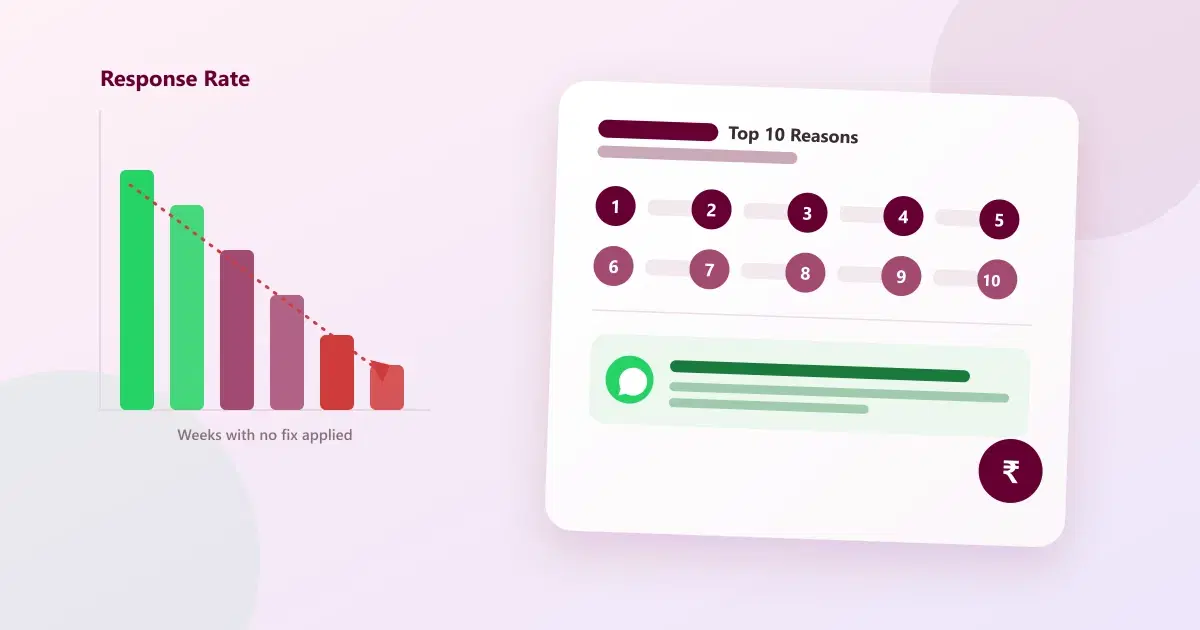
If your WhatsApp response rate has quietly dropped, here are the top 10 reasons customers stop replying — generic messages, over-messaging, unfamiliar numbers, and more — with the specific fix for each, and how Cleomitra solves them from ₹999/month.
A business sends a WhatsApp message — a reminder, an offer, a follow-up — and the customer just... doesn't reply. No error, no unsubscribe, just silence. When this happens once, it's easy to ignore. When it happens across most of your customer list, your WhatsApp response rate quietly collapses, and with it, the bookings, repeat sales, and retention that WhatsApp was supposed to drive.
Low WhatsApp engagement almost always traces back to one of the same ten causes. Here they are, in order of how often they show up, with the specific fix for each.
Why Customers Stop Responding on WhatsApp
WhatsApp has some of the highest open rates of any messaging channel — customers genuinely do read the message. The problem is rarely that the message goes unseen. It's that the message doesn't earn a reply, because of how, when, or from where it was sent. Fixing WhatsApp response rates is less about sending more messages and more about removing the specific reasons customers decide it's not worth replying to this one.
Top 10 Reasons Customers Stop Responding on WhatsApp
1. Messages Feel Like Generic Broadcast Spam
A message that's clearly the same blanket text sent to everyone — no name, no context, no relevance to that specific customer — reads as spam even when it's a genuine offer. Customers who feel unread by a business message stop reading the next one.
Fix it: Personalize messages using data already in your CRM — the customer's name, their last visit, or the service they usually book — so the message reads as written for them, not blasted at everyone.
2. Too Many Messages, Too Often
Message fatigue is real. A business that sends a reminder, then a follow-up, then an offer, then another reminder — all within days — trains customers to stop opening messages from that number altogether.
Fix it: Space out automated messages and cap frequency per customer, so reminders and offers don't stack up into a flood that trains customers to tune out.
3. Replies Take Too Long to Get a Response
When a customer does reply — asking a question, requesting a change — and hears nothing back for hours, they learn that replying doesn't actually get them anywhere. The next message from that business gets ignored on principle.
Fix it: Use a shared team inbox with automated acknowledgment, so every reply gets picked up quickly instead of sitting unread in one staff member's personal phone.
4. Messages Come From an Unfamiliar Number
A message from a number the customer doesn't recognize — because the business switched to a new WhatsApp API number — is far more likely to be ignored or reported, even if the content is legitimate.
Fix it: Use WhatsApp Coexistence so automated messages go out from the same number the customer already has saved and has messaged before, instead of a new, unfamiliar one.
5. There's No Clear Reason to Reply
A message that just states information with no question, no next step, and no reason to respond gives the customer nothing to reply to — so most won't.
Fix it: End messages with a specific, easy action — "Reply YES to confirm" or "Tap to reschedule" — rather than a one-way announcement.
6. Messages Arrive at the Wrong Time
A promotional message at 7 AM or a reminder sent late at night gets swiped away on reflex, regardless of how relevant the content is.
Fix it: Schedule automated messages for hours when customers are actually likely to check WhatsApp casually, rather than whenever the automation happens to trigger.
7. The Message Feels Robotic
Stiff, over-formal, clearly-templated language signals "automated system" rather than "a business I have a relationship with" — and customers respond to businesses, not systems.
Fix it: Write automated templates in the same natural tone a staff member would actually use, and reference the customer's specific context so it doesn't read as generic.
8. The Same Message Repeats Without New Information
Sending an identical reminder two or three times with nothing new in it reads as nagging rather than helpful, and customers disengage rather than reply to a message they've already seen.
Fix it: Vary follow-up messages — a second reminder should add new information (a deadline, an offer) rather than repeating the first one verbatim.
9. Messages Feel Intrusive, With No Way to Opt Out
Customers who feel they have no control over how often a business messages them are more likely to go silent — or block the number entirely — than to ask to be messaged less.
Fix it: Make it easy to reduce frequency or opt out of promotional messages specifically (while keeping essential ones like appointment reminders), so customers stay reachable instead of blocking the number.
10. The Message Isn't in the Customer's Preferred Language
A message in English to a customer who's more comfortable in Tamil or Hindi is more likely to be skipped, even if they can technically read it, simply because it takes more effort to engage with.
Fix it: Send messages and offer support in the customer's preferred language rather than defaulting to English for everyone.
How Cleomitra Fixes WhatsApp Response Problems
Each fix above is achievable individually, but sustaining all ten manually — personalization, timing, frequency caps, fast replies, familiar numbers, multilingual support — is difficult without a system built for it. Cleomitra addresses this directly:
- WhatsApp Coexistence keeps automated messages going out from the same number customers already recognize, instead of a new one
- An omnichannel CRM pulls in customer history — past visits, preferences, prior conversations — so messages can be personalized instead of generic
- A shared team inbox ensures customer replies get picked up quickly instead of sitting unread
- AI-powered auto-replies handle common questions instantly, even outside business hours, so a reply always comes quickly
- Tamil, Hindi, and English support lets messages go out in the language a customer is actually comfortable with
Cleomitra combines these into one platform starting from ₹499 per month, so improving WhatsApp response rates doesn't depend on staff remembering to do all ten things manually, every time.
Conclusion
Customers going quiet on WhatsApp is rarely about the channel — WhatsApp remains one of the most-opened messaging apps available. It's almost always about how the message was sent: generic, too frequent, from an unfamiliar number, at the wrong time, or in the wrong language. Fixing these ten specific issues, rather than simply sending more messages, is what actually rebuilds a WhatsApp response rate that's gone quiet.
Frequently Asked Questions
Why do customers stop responding on WhatsApp?
The most common reasons are messages that feel like generic broadcast spam, being sent too frequently, coming from an unfamiliar number, arriving at the wrong time of day, sounding robotic, or not being in the customer's preferred language — not a lack of interest in the business itself.
How can a business improve its WhatsApp response rate?
Personalize messages using customer history, cap how often automated messages are sent, reply quickly when customers do respond, keep messaging from the same familiar number using WhatsApp Coexistence, and send messages in the customer's preferred language.
Does WhatsApp Coexistence help with customer response rates?
Yes. WhatsApp Coexistence lets a business keep sending automated messages from the same number customers already have saved and have messaged before, instead of switching to an unfamiliar new number, which reduces messages being ignored or reported as spam.
Why do customers ignore WhatsApp reminders specifically?
Reminders are often ignored when they repeat the same message without new information, arrive at an inconvenient time, or sound automated rather than personal. Adding new information to follow-up reminders and timing them around when customers are likely to check WhatsApp casually improves response rates.
Does Cleomitra help businesses get more replies on WhatsApp?
Yes. Cleomitra combines WhatsApp Coexistence, an omnichannel CRM for personalization, a shared team inbox for fast replies, AI-powered auto-replies, and multilingual support (Tamil, Hindi, and English) starting from ₹499 per month.
Is it better to send WhatsApp messages in English or a regional language?
It depends on the customer's own preference. A message in a customer's preferred language, such as Tamil or Hindi, is generally more likely to get a response than defaulting to English for every customer regardless of comfort level.
How often should a business send WhatsApp messages to avoid being ignored?
There's no universal number, but sending reminders, follow-ups, and offers back-to-back within a short span trains customers to stop opening messages. Spacing messages out and capping frequency per customer helps maintain engagement over time.
